

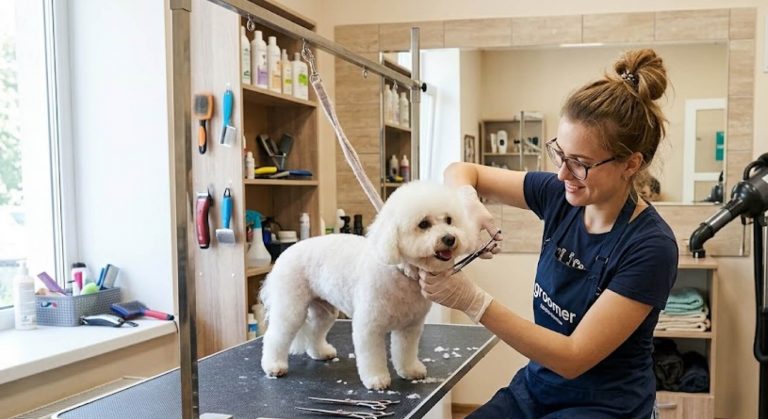
How often does a dog need to be trimmed?
February 20, 2026
Read


Prices depend on the breed, size and condition of the animal's coat
Dog and cat trimming is a service that tends to leave owners with more questions than answers. Does my pet actually need trimming? How often? And does shaving in summer really help? The articles in this category provide concrete information based on breeds and coat types — separately for dogs and separately for cats — because the rules work in entirely different ways for each.
Not every dog visits the salon for a trim. That is the first thing worth understanding. Dog trimming applies to breeds whose coats grow continuously and do not shed on their own without regular intervention: poodles, bichon frises, Maltese, schnauzers, and cocker spaniels. For these breeds, a visit every 6–8 weeks is not an indulgence — it is a necessity.
Huskies, German Shepherds, and Labradors do not require trimming and should not be shaved. Cutting the coat too short disrupts natural thermoregulation and strips the skin of its protection against the sun. This is a mistake owners make particularly in summer, assuming the dog will feel cooler. In reality, the opposite is true.
A dog’s trim at the groomer always begins with a bath and thorough blow-dry — only on clean, brushed-out coat can you cut evenly and safely. Attempting to trim a wet or matted dog results in an uneven finish and unnecessary discomfort for the animal. With breeds prone to matting, the groomer sometimes has to remove the knots first and then style the coat — making the visit significantly longer than it would be for a regularly maintained dog.
Cat trimming raises more doubts than dog trimming. A cat washes itself and takes care of its own coat — so why involve a groomer? Short-haired domestic cats can go their entire lives without any specialist intervention. Persians, Maine Coons, Ragdolls, and Angoras are a completely different story: their coats thicken, tangle, and without regular attention form matts that owners often do not notice until they have already pressed tight against the skin.
Clipping a long-haired cat with clippers is the only safe option when matts are severe. Attempting to untangle dense, felted fur close to the skin causes pain and stress — and the skin beneath a matt is often irritated or chafed. In such cases, trimming a cat at the groomer is not an aesthetic procedure but a necessary intervention.
The visit itself looks different with a cat than with a dog: less noise, a calmer pace, less time under the dryer. A cat that is highly stressed during its first visit may need the procedure split into two sessions. At Bruno Grooming, such decisions are made by the groomer as the visit unfolds — the animal’s wellbeing takes priority over completing everything in a single appointment.
For breeds that require regular coat correction, it is worth booking professional dog trims in advance. Visiting the salon every 6–8 weeks is the rhythm that keeps the coat in good condition without the need for drastic interventions. With longer gaps between visits, the coat grows unevenly, matts form, and the next appointment takes twice as long.
For cats, frequency depends on the breed and on what the owner does at home. A Persian that is brushed daily needs a salon visit every 10–12 weeks. A Persian that nobody brushes arrives at the salon with matts every six weeks — and the visit then consists mainly of removing them. Regular brushing between appointments is the only effective preventive measure.
It is also worth remembering that trimming — whether for a dog or a cat — is a good opportunity to assess the condition of the skin. During a visit, the groomer sees the animal differently from how the owner sees it day to day: evaluating the skin, reacting to redness, checking ears and claws. These details, observed during regular visits, allow early warning signs of problems to be caught before they become serious.
Dog and cat trimming is a topic that brings together knowledge of breeds, coat types, and care routines. The articles in this category will help you plan salon visits more effectively and understand what your pet truly needs.
When matts are advanced, the only safe solution is clipping with a trimmer by an experienced groomer. Attempting to untangle dense, felted fur close to the skin causes pain and stress for the animal, and the skin beneath a matt is often irritated or chafed. The sooner you visit the salon, the lower the risk of skin complications.
Yes — and the effect is clearly negative. Both breeds have a double coat: a soft undercoat and a coarser outer coat. After clipping, the outer coat may grow back unevenly, change texture, or fail to recover properly. This condition is known as post-clipping alopecia and is one of the main reasons these breeds should not be clipped.
For a medium-sized dog with a coat in good condition — such as a cocker spaniel or schnauzer — a visit typically takes between one and a half to two and a half hours. The time increases if the coat is matted, the dog is nervous, or additional hygienic procedures are required.
The first trim is recommended after the puppy has completed its full vaccination schedule — usually around four months of age. Before that, however, it is worth bringing the puppy to the salon for a short introductory visit so it can get used to the new environment, sounds, and the groomer's touch before the actual procedure begins.